Realized vs. Unrealized P&L on Kalshi
Realized P&L is the gain or loss locked in when you sell contracts or a market settles: proceeds or payout minus what you paid and the fees. Unrealized P&L is the current gain or loss on positions you still hold, based on their present value, and it can change until you close them or the market settles.
A simple example
$40 in, $55 on screen.
You buy 100 contracts at $0.40, so they cost $40. The purchase is a taker order, so you also pay a $1.68 fee. Later, the position’s displayed value is $55.
- Displayed value
- $55.00
- Purchase cost
- −$40.00
- Unrealized, before fees
- +$15.00
Including the $1.68 purchase fee, you are ahead $13.32 on paper. Nothing is realized yet: the value can move, and selling has its own fee.
If you sell all 100 at $0.55
- Sale proceeds
- $55.00
- Purchase cost
- −$40.00
- Purchase fee
- −$1.68
- Sale fee
- −$1.74
- Realized P&L
- +$11.58
If you hold to settlement instead
- Wins: payout $100 − $40 − $1.68
- +$58.32
- Loses: payout $0 − $40 − $1.68
- −$41.68
Illustrative amounts. Fees use Kalshi’s published taker formula, round up(0.07 × contracts × price × (1 − price)), with the default multiplier, rounded up to the cent. Kalshi charges no settlement fee. Your market’s fees and actual sale price may differ.
Realized P&L: locked in.
A result is realized once the position is closed, either by selling or because the market settled. For a closed position, realized P&L is:
Sale proceeds or settlement payout − purchase cost − trading fees
Kalshi pays $1 per contract on the winning outcome of a simple binary contract and $0 otherwise, and charges no settlement fee. Selling part of a position realizes only that part. Which purchases count as sold depends on the cost-basis method; Kalshi’s P&L statement uses first-in, first-out (FIFO).
Unrealized P&L: still open.
Unrealized P&L compares what your open positions are currently worth with what you paid for them. It changes with the market, and it can disappear if the market goes against you before you close.
“Currently worth” needs care. Kalshi describes position values as displayed values, not guaranteed sale amounts. In the mobile app, a position’s current value is a cash-out estimate based on available bids and estimated sell fees, and thin liquidity may cover only part of a large position.
How they fit together.
| Realized | Unrealized | |
|---|---|---|
| Applies to | Contracts sold or settled | Contracts you still hold |
| Can it change? | No, once recorded | Yes, with the market |
| Based on | Actual proceeds and payouts | Current displayed or estimated value |
| Fees | Fees on the closed trades | Purchase fees, plus a future sale fee if you sell |
Your total trading result is realized plus unrealized. Neither includes deposits, withdrawals, or credits; those are funding, not trading results.
How Damage Report separates them.
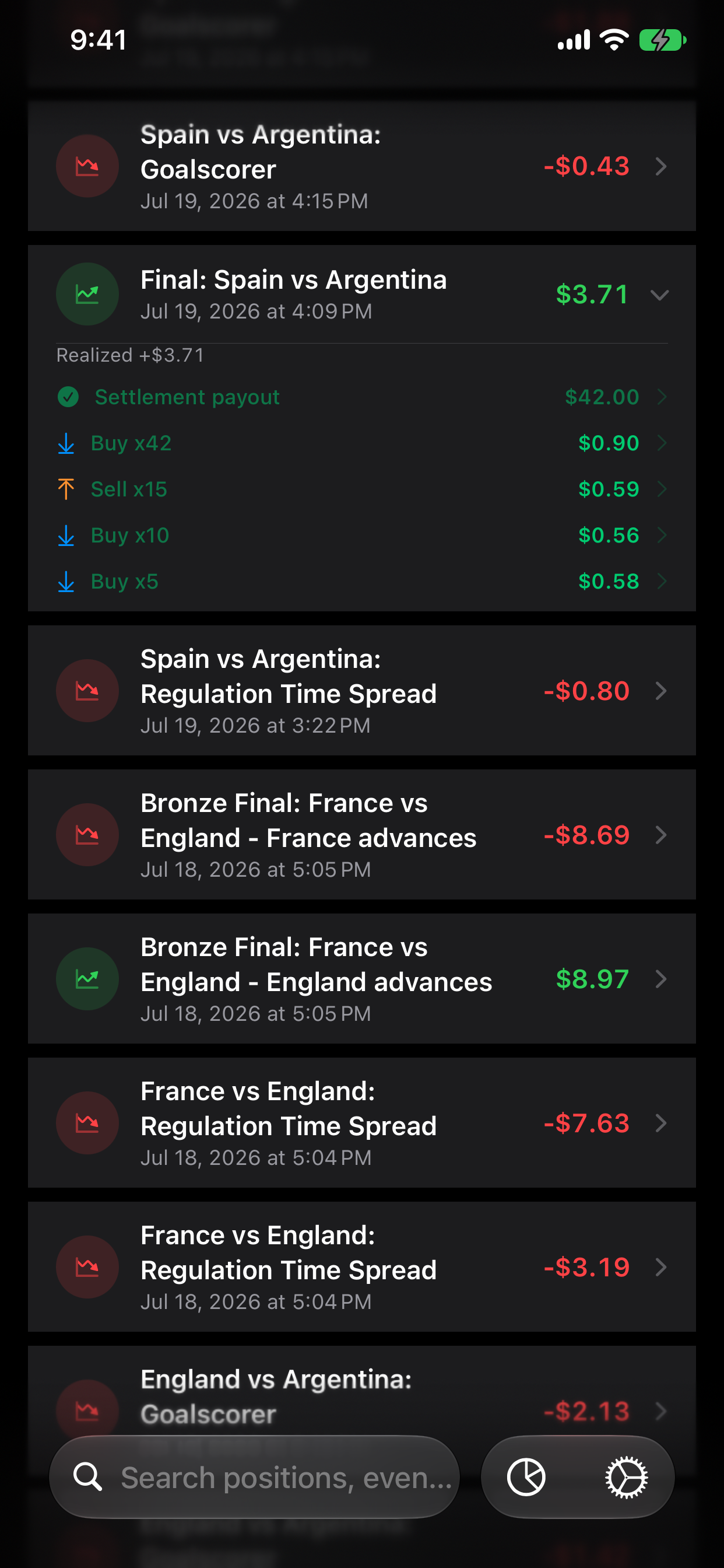
Damage Report shows combined, realized, and unrealized P&L side by side. Realized P&L accounts for proceeds, the purchase cost of the contracts closed, and recognized trading fees. Unrealized P&L compares current value with the purchase cost and reserved fees of open positions, and is labeled unknown when a market value is missing. Fees on a position that is still open stay with unrealized P&L until it fully closes. How the app calculates these numbers.
Primary sources
- Kalshi Help Center: Portfolio — balances and positions
- Kalshi Help Center: Market FAQs (settlement)
- Kalshi fee schedule (PDF)
- Kalshi API documentation: Fee rounding
- Kalshi Help Center: What tax documentation does Kalshi provide?
Sources checked October 5, 2026. Kalshi can change its products, fees, and documents; its current pages take precedence over this guide.