How Kalshi Fees Affect Your Actual Profit
Kalshi charges a trading fee on orders that match immediately, calculated from the number of contracts and the price, and highest for contracts priced near $0.50. There is no settlement fee. Your actual profit is your gross result (proceeds or payouts minus purchase cost) minus those fees, so frequent or small-margin trades can turn a gross gain into a net loss.
A worked example
Gross $1.50, net $1.15.
You buy 10 contracts at $0.40 and later sell all 10 at $0.55. Both orders match immediately (taker), in a market with the default fee multiplier.
- Sale proceeds: 10 × $0.55
- $5.50
- Purchase cost: 10 × $0.40
- −$4.00
- Gross result
- +$1.50
- Purchase fee: 0.07 × 10 × 0.40 × 0.60 = $0.168
- −$0.17
- Sale fee: 0.07 × 10 × 0.55 × 0.45 = $0.173
- −$0.18
- Net result
- +$1.15
Fees took about 23% of the gross gain here. Held to a winning settlement instead, the same contracts pay $10.00, for a net result of $10.00 − $4.00 − $0.17 = $5.83, because Kalshi charges no settlement fee.
Illustrative amounts. Fees rounded up to the cent, as Kalshi’s fee table shows. Your market’s multiplier and rounding may differ.
How Kalshi calculates trading fees.
Kalshi’s published fee schedule (effective July 7, 2026) gives the general taker fee as:
fee = round up(M × 0.07 × C × P × (1 − P))
where C is the number of contracts, P is the price in dollars, and M is a market multiplier (1 unless the schedule lists otherwise). Because of the P × (1 − P) term, the fee per contract is highest near $0.50 and smaller near $0.01 or $0.99. Kalshi’s table shows, for example, $0.02 for one contract at $0.50 and $1.75 for 100.
- Taker and maker. Kalshi charges trading fees on orders that are immediately matched. Resting orders are charged only in markets listed with maker fees, using a 0.0175 rate. Canceling a resting order is free.
- Market multipliers. Some series have different multipliers, including some with no fees. Check the schedule for the market you trade.
- No settlement or membership fee. Holding to settlement adds no fee.
- Rounding. Kalshi’s API documentation says most member balances are aligned to the cent, so small fees round up, and that the net fee is the trade fee plus any rounding fee minus any rebate.
- Funding fees are separate. Kalshi lists no fee for ACH deposits and withdrawals and up to 2% on card deposits. Those are costs of moving money, not trading fees.
Gross result → fees → net result.
Your gross result is proceeds or payouts minus what you paid. Your net result subtracts the fees on those trades. The net figure is what you actually made, and the one to compare with your account. Kalshi’s P&L statement reports figures that include fees and any rebates.
Why fees matter more than they look.
- A trade can be a gross win and a net loss when the price moves only a cent or two.
- Trading in and out of a position many times pays fees on every trade.
- Fees on positions that are still open have been paid, but the result they belong to isn’t realized yet.
So the useful question is not just “how much did I pay in fees?” but “how much of my gross result did fees take, and where?”
See your actual fees.
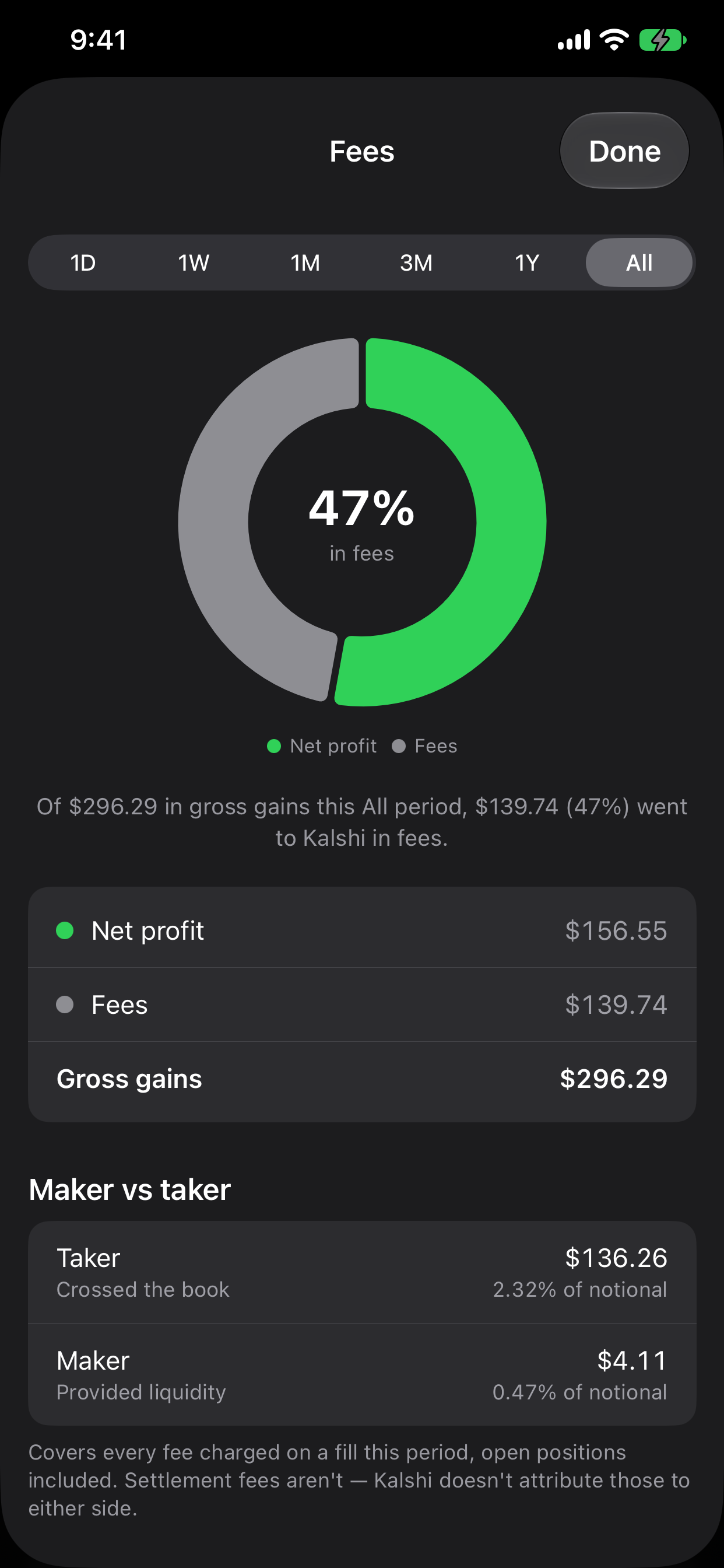
Damage Report shows your fees for any period next to your net results, with totals by market and by maker and taker activity. Fees are already included in its P&L figures; the Fees view explains them, so you don’t subtract them twice.
Primary sources
- Kalshi fee schedule (PDF)
- Kalshi Help Center: Fees
- Kalshi API documentation: Fee rounding
- Kalshi Help Center: Card deposits
- Kalshi Help Center: Bank withdrawals
- Kalshi Help Center: What tax documentation does Kalshi provide?
Sources checked October 5, 2026. Kalshi can change its products, fees, and documents; its current pages take precedence over this guide.